For twenty-four years, there had been an empty chair at our Thanksgiving table.
When I was nine, I believed my mother would return before the pumpkin pie was served.
When I was sixteen, I pretended I didn’t care.
When I was twenty-five, I told my husband it was simply a family tradition.
And when I turned thirty-three, I finally admitted the truth.
I had kept that chair empty because some part of me was still waiting.
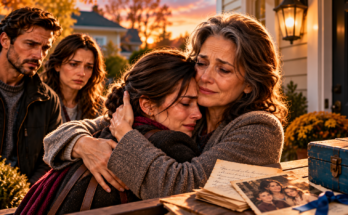
Now my mother stood in front of me on a quiet porch outside Cincinnati.
Her hair was streaked with silver.
Her hands trembled as she held mine.
And when I told her we’d been saving her seat, she began to cry.
“Emily,” she whispered, “I don’t deserve that.”
I looked at the woman I had missed for most of my life.
“Maybe this isn’t about what anyone deserves.”
She wiped her cheeks.
“Then what is it about?”
I thought about the letters.
The secrets.
The years my brother and I had spent believing we weren’t wanted.
“It’s about deciding what happens next.”
Behind me, Ben stepped forward.
“Come home with us, Mom.”
She looked from him to me.
“Are you sure?”
I nodded.
“Not because everything is fixed. It isn’t. But we can start somewhere.”
For the first time that day, she smiled.
“Then I’d like to come.”
The drive home was quieter than I expected.
Mom sat beside Clara in the back seat.
For years, I’d imagined that finding my mother would mean getting her entirely to myself.
Instead, I was watching her hold the hand of a woman she’d helped raise.
Clara had lost her mother too.
Not in the same way.
But the loneliness was familiar.
“Have you spoken to Anna again?” Mom asked her.
Clara nodded.
“She’s waiting for my call.”
Mom squeezed her hand.
“Are you going to see her?”
“I think so.”
“Good.”
Clara looked at her.
“Are you angry that she stayed away?”
Mom took a moment before answering.
“I’m sad about the years you lost. And I wish she had found a way back sooner.”
“Do you think I should forgive her?”
“That’s something only you can decide.”
I glanced at them in the rearview mirror.
It was the first time I’d heard my mother speak about forgiveness.
And I realized she wasn’t asking Clara to forget the past.
She was giving her permission to feel whatever she felt.
I wished someone had done that for Ben and me when we were children.
When we reached my house, Daniel was waiting by the front door.
Sophie stood beside him wearing a yellow sweater.
“Mommy!” she called.
I knelt and hugged her.
Then she noticed the woman standing behind me.
“Who’s that?”
I looked at Catherine.
My mother’s eyes filled with tears.
“Sophie,” I said softly, “this is your grandma.”
Sophie tilted her head.
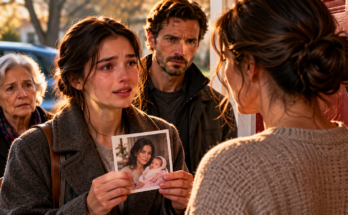
“The grandma in the pictures?”
I nodded.
“Yes.”
Sophie studied her for a moment.
Then she walked forward.
“Do you like books?”
Mom laughed through her tears.
“Very much.”
“I have lots of books.”
“I’d love to see them.”
Sophie reached for her hand.
“Come on. I’ll show you my favorites.”
Mom looked at me, almost asking permission.
I smiled.
“Go ahead.”
And just like that, my daughter led my mother into our home.
No speeches.
No explanations.
Just a little girl showing her grandmother a bookshelf.
I stood in the doorway and cried.
Because sometimes the smallest moments are the ones you never believed you’d live to see.
That evening, Ben and I sat with Mom at the kitchen table.
Daniel had taken Sophie upstairs.
Clara had gone to make another call to Anna.
For the first time, it was just the three of us.
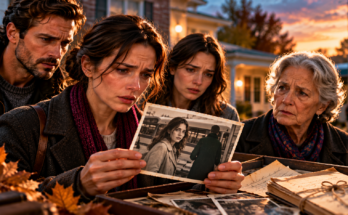
Mom looked at the photographs spread across the table.
“Your father kept all of these?”
“Yes,” Ben said.
She touched a birthday card.
“I wondered where they went.”
I watched her carefully.
“Why didn’t you find another way to contact us?”
Mom looked at me.
It was the question I’d carried for twenty-four years.
She didn’t look away.
“I tried several ways. But I also gave up on some chances because I was afraid another argument would hurt you.”
“Did you believe Dad when he said we were better off without you?”
“Part of me wanted to believe he knew what you needed.”
I shook my head.
“We needed you.”
“I know that now.”
“You should have known it then.”
Mom lowered her eyes.
“You’re right.”
I hadn’t expected her to agree.
For years, I’d imagined excuses.
Arguments.
A thousand reasons why she couldn’t have done anything differently.
But she didn’t offer them.
She simply said, “I’m sorry.”
Ben leaned back in his chair.
“I loved Dad.”
Mom nodded.
“So did I, once.”
“He was good to us in a lot of ways.”
“I know.”
“But he lied.”
“Yes.”
Ben looked down.
“I don’t know how to remember him anymore.”
Mom reached across the table.
“You can remember the good things without pretending the bad things didn’t happen.”
I stared at her.
It was the first answer that felt honest.
Dad had been the man who taught me to ride a bicycle.
He’d sat through every school concert.
He’d held my hand at the hospital when Sophie was born.
And he’d kept my mother’s letters hidden.
All of those things were true.
I didn’t have to choose only one.
Later that night, Clara came downstairs.
Her face was pale, but she was smiling.
“I spoke to Anna.”
Mom stood.
“How is she?”
“She’s nervous.”
Clara laughed softly.
“So am I.”
“Are you meeting her?”
“Tomorrow morning.”
I walked toward her.
“Do you want me to come?”
Clara nodded.
“Please.”
Then she looked at Mom.
“And you too.”
Mom’s eyes filled with tears.
“I’d be honored.”
Anna chose a quiet café outside town.
She was already sitting near the window when we arrived.
Her hair was dark with streaks of gray.
She wore a simple blue sweater.
A cup of tea sat untouched in front of her.
Clara stopped at the entrance.
I could feel her trembling.
“That’s her,” she whispered.
Anna looked up.
For a moment, neither moved.
Then Anna stood.
“Clara?”
Clara took one step.
Then another.
“Mom?”
Anna began crying.
“I don’t know what to say.”
Clara looked at her.
“Neither do I.”
Anna reached out.
“May I hug you?”
Clara hesitated.
Then she nodded.
They embraced beside the little café table.
It wasn’t a perfect reunion.
There were questions Anna would have to answer.
There were years she could never give back.
But Clara was finally standing in front of the woman whose letter she’d carried for days.
And Anna was finally able to tell her daughter she loved her without a telephone between them.
We gave them space to talk.
Mom and I sat at a nearby table.
After a while, Anna joined us.
She looked at Catherine.
“I’m sorry.”
Mom nodded.
“I know.”
Anna turned toward me.
“Emily, I owe you an explanation too.”
I waited.
“Your mother stayed at Willowbrook because she believed Clara and I needed help. I was frightened of Thomas, and I made choices that separated me from my daughter.”
She looked down.
“Richard helped at first. Then he became afraid that Thomas would involve his family.”
“And you went to Columbus?” I asked.
“Yes.”
“Why didn’t you return?”
Anna’s eyes filled with tears.
“I was ashamed. I was afraid. And the longer I stayed away, the harder it became to imagine coming back.”
Clara sat beside her.
“That’s not an answer that makes everything better.”
Anna nodded.
“I know.”
“But it’s an answer.”
Anna reached for her hand.
“And I’ll keep answering your questions for as long as you need.”
I watched them.
For years, I had believed reunions happened in a single dramatic moment.
A door opening.
A hug.
A happy ending.
But real reunions were quieter.
They happened in conversations.
In difficult questions.
In choosing to return the next day.
And the day after that.
There was one mystery I still needed to solve.
The anonymous messages.
The photograph of Anna at the bus station.
The warnings about Margaret.
After breakfast, I showed Anna the messages.
She studied them carefully.
“I didn’t send these.”
“Do you recognize the photograph?”
She nodded.
“That was the day my mother helped me leave town.”
“Who took it?”
“I don’t know.”
“Could Thomas have taken it?”
Anna looked uncertain.
“It’s possible. But I don’t have any evidence.”
I looked at Catherine.
“Did you send any messages?”
She shook her head.
“No.”
Then Clara spoke.
“Wait.”
She opened her phone and scrolled through an old email thread.
“There’s someone I should have told you about.”
She showed us a message from a man named Michael Reed.
“Michael is Thomas’s younger brother. He contacted me several months ago.”
Anna went still.
“Michael?”
Clara nodded.
“He said he’d found old family photographs after Thomas died. He wanted to know whether I was interested in them.”
I stared at her.
“Did he send the bus-station picture?”
“I don’t know. I never replied after the first message.”
Anna leaned forward.
“Michael was kind to me when I was younger. He knew I wanted to leave.”
“Do you think he knew where you went?” I asked.
“Maybe.”
Clara looked at the anonymous messages again.
“Then we should ask him.”
Michael answered Clara’s call that afternoon.
He sounded surprised.
Then relieved.
“Clara? I’m glad you called.”
She put him on speaker.
“Michael, did you send Emily Carter some messages?”
There was a pause.
“Yes.”
I leaned forward.
“Why didn’t you tell us who you were?”
“I wasn’t sure you’d believe me. And I didn’t know how much of the past your families had discussed.”
“How did you get the photograph?”
“I found it among Thomas’s papers after he died. There were several photographs from 1998.”
“Did Thomas take them?”
“I believe so. But I can’t prove who took each one.”
“Why warn me about Margaret?”
Michael sighed.
“Because the photograph showed she knew Anna had left town safely. I thought you deserved to ask why she hadn’t told Catherine.”
I looked at Anna.
She was listening quietly.
“Did you know where Anna went?” I asked him.
“No. I hoped she was safe.”
“Why send the messages now?”
“After Richard died, I heard Catherine might finally be trying to reconnect with her children. I thought the photograph could help explain what happened.”
“You could have simply told us who you were.”
“You’re right. I handled it badly.”
I looked at the messages on my phone.
The mysterious warnings that had frightened us.
They hadn’t come from a stranger trying to harm our family.
They’d come from someone who believed he was helping us find the truth.
But secrecy had only created more fear.
“Michael,” I said, “next time, tell the truth plainly.”
“I will.”
When the call ended, I put my phone down.
For the first time since Thanksgiving, I felt the mystery begin to loosen its grip on us.
There were still things we didn’t know about 1998.
There might always be.
But the central truth was finally clear.
Our family had been separated by fear, pride, and silence.
And none of those things had ever meant we were unloved.
That afternoon, I visited my father’s grave.
I went alone.
The cemetery was quiet.
I stood beside the stone bearing his name.
Richard Carter.
Beloved Father.
I stared at those words for a long time.
“Dad,” I whispered, “I found her.”
The wind moved through the trees.
“She’s alive. She’s okay.”
I looked down.
“I wish you’d told us.”
My voice shook.
“I wish you’d trusted us enough to let us know the truth.”
I thought of the box he’d given Ben before he died.
Maybe it had been his final attempt to correct what he’d done.
Maybe he had finally understood how much damage his silence had caused.
I would never know exactly what he’d been thinking.
But I knew I didn’t want to carry the same silence into my daughter’s life.
“I love you, Dad,” I whispered.
“And I’m angry with you.”
I stood there for a while.
Then I turned toward home.
Both feelings came with me.
And for once, I let them.
Three days later, we gathered for another Thanksgiving dinner.
It wasn’t the official holiday anymore.
The leftovers were gone.
The decorations were slightly crooked.
But Sophie insisted that if Grandma had missed Thanksgiving, we should simply have another one.
Daniel cooked a fresh turkey.
Ben brought pies.
Clara and Anna came together.
Margaret arrived carrying flowers.
And Catherine stood in my kitchen, helping Sophie set the table.
I watched them from the doorway.
My daughter handed Mom a folded napkin.
“Grandma, this one is for your seat.”
Mom smiled.
“Thank you, sweetheart.”
Sophie pointed toward the dining room.
“Mommy says we’ve been saving it for you.”
Catherine looked at me.
Her eyes filled with tears.
I walked toward her.
“Are you ready?”
She nodded.
“I think so.”
Everyone gathered around the table.
Ben sat beside Clara.
Anna sat across from Margaret.
Daniel lifted Sophie into her chair.
And my mother stood beside the one seat that had remained empty for twenty-four years.
I pulled it out.
“Mom.”
She looked at me.
“Yes?”
“Your place is here.”
She sat down slowly.
For a moment, nobody spoke.
Then Sophie looked around the table.
“Why is everybody crying?”
Ben laughed.
“Because we’re happy.”
Sophie frowned.
“That’s a funny reason to cry.”
Everyone laughed.
Even Mom.
Especially Mom.
And the sound of her laughter filled a room that had been missing it for most of my life.
Before dinner, I stood to say something.
I hadn’t prepared a speech.
I didn’t know if the words would come out right.
But I wanted to try.
“When I was little,” I began, “I thought families were supposed to stay exactly the same forever.”
I looked at Ben.
“Then Mom left, and everything changed.”
I looked at Catherine.
“For a long time, I thought the empty chair meant someone had chosen not to love us.”
Mom wiped her eyes.
“But I’ve learned that love can exist alongside mistakes. And that loving someone doesn’t erase the harm they’ve caused.”
I looked around the table.
“We have a lot to talk about. We have a lot to learn about each other.”
Ben nodded.
“But tonight, I want to be thankful that we’re finally talking.”
I looked at my mother.
“And that you’re here.”
She reached for my hand.
“I’m thankful too.”
Daniel raised his glass.
“To new beginnings.”
“To new beginnings,” everyone repeated.
Sophie lifted her cup of apple juice.
“And to pie!”
We laughed again.
Later, after everyone had gone home, Mom and I stood together in the kitchen.
The dishes were stacked beside the sink.
Sophie was asleep upstairs.
The house was quiet.
Mom looked toward the dining room.
“Emily?”
“Yes?”
“Thank you for letting me sit there.”
I shook my head.
“You don’t have to thank me.”
“I do.”
She looked at the table.
“I spent so many years believing there would never be a place for me in your life again.”
I took her hand.
“We can’t get those years back.”
“I know.”
“And I can’t promise everything will be easy.”
“I wouldn’t ask you to.”
I smiled through my tears.
“But I’d like you to come for Christmas.”
Mom laughed softly.
“I’d love that.”
“And Sophie’s school play.”
“Of course.”
“And maybe we could have coffee next week.”
She squeezed my hand.
“I’d like that most of all.”
That night, I walked into the dining room one last time.
The table was empty.
The candles had burned low.
The chairs were pushed in.
All except one.
Mom’s chair.
For twenty-four years, I’d kept it empty because I couldn’t let go of the past.
Tonight, I pushed it gently beneath the table.
Not because I’d stopped remembering.
Not because everything had been forgiven.
But because the waiting was finally over.
The chair no longer represented someone who was missing.
It represented someone who had returned.
I turned off the light.
And as I walked upstairs, I heard Sophie call from her bedroom.
“Mommy?”
“Yes, sweetheart?”
“Will Grandma come back tomorrow?”
I smiled.
“I think she will.”
“Good,” Sophie whispered. “I have another book for her to read.”
I stood in the hallway for a moment.
Then I smiled through my tears.
Twenty-four years ago, I had been a little girl waiting for her mother to come home.
Tonight, my daughter was waiting for her grandmother to return.
But this time, we knew she was coming.
THE END
The Empty Chair at Thanksgiving is an original fictional family drama about secrets, forgiveness, and finding a way home.