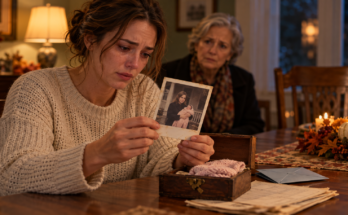
Emily read the words until they stopped looking like handwriting.
She came for Emily. I told her no.
For twenty-four years, she had imagined her mother somewhere far away, living a life that had no room for her children.
Now she had a photograph of that same woman standing outside their house.
Close enough to knock.
Close enough to hear them.
And her father had sent her away.
“Why would he write that down?” Daniel asked.
Emily turned the Polaroid over again.
Her mother stood beneath the porch light, holding the baby against her coat. She wasn’t looking into the camera.
She was looking toward the door.
“Maybe he wanted to remember what he’d done,” Ben said.
Margaret shook her head.
“Or he wanted someone else to know.”
Emily looked at her.
“Who?”
“I don’t know.”
The room went quiet.
Then Ben whispered, “December third.”
Emily turned toward him.
He was staring at the photograph.
“That was the night Dad sent me upstairs.”
THE SOUND AT THE DOOR
“You remember?”
Ben rubbed his hands against his knees.
“Not all of it.”
“You were four.”
“I know.”
Emily waited.
Ben looked toward the hallway, as though the door to their childhood home might somehow appear there.
“I was sitting on the living-room floor. There was a cartoon on television. Dad turned the sound up.”
“What happened before that?”
“A knock.”
Emily’s grip tightened on the photograph.
“Did you see her?”
“No. Dad told me to go upstairs. I didn’t want to because the cartoon wasn’t finished.”
Ben swallowed.
“He picked me up. Not gently.”
Emily remembered her father carrying Ben upstairs when he refused to go to bed.
She had never thought to ask why he was crying that night.
“I heard a woman,” Ben continued. “I thought it was someone selling something.”
“What did she say?”
Ben closed his eyes.
“I remember her saying, ‘Let me see them.’”
Emily lowered the photograph.
Them.
Not just Emily.
Both of them.
“I don’t remember what Dad said,” Ben added quickly. “I’m sorry. I’ve tried, but I don’t.”
“You don’t have to make yourself remember more.”
The words surprised Emily as she said them.
For the first time that evening, she could see the little boy her brother had been.
A child sent upstairs.
A child who had grown up inside the same story she had.
THE LETTER MARGARET RECEIVED
Daniel pulled Margaret’s photograph closer.
“The picture in the mailbox came with a note.”
Margaret nodded.
“You said it told you to bring everything here on Thanksgiving. Do you still have it?”
“In my handbag.”
She reached beneath her chair and removed a folded sheet.
Emily had been so focused on her mother’s letter that she had barely thought about the other one.
This note was printed.
No signature.
No handwriting to recognize.
Margaret,
You kept her letter. Richard kept the rest.
Emily deserves to see both.
Take the photograph and the letter to her on Thanksgiving. Make sure Benjamin is there.
If you still have the staff address book, look under Bennett.
Emily read the final line again.
“Bennett?”
Margaret nodded.
“I looked before I came.”
“And?”
“There was a Ruth Bennett. She worked on the maternity ward.”
“Have you spoken to her?”
“The number in the book no longer works.”
Emily stared at the note.
“Why didn’t you show me this earlier?”
“Your brother recognized the photograph. Then you opened the letter, and everything happened so quickly.”
Margaret’s voice trembled.
“I thought we would get to it.”
Daniel pointed at the second sentence.
“Whoever sent this knew about Richard’s box.”
Ben leaned closer.
“And knew I had it.”
Nobody spoke.
The person behind the photograph had not simply found Emily’s name.
They knew where the pieces of her family’s history had been hidden.
THE RETURN ADDRESS
Emily gathered the hospital pages again.
Birth record.
Discharge acknowledgment.
Receipt.
She had been looking for names and signatures.
Now she searched the corners, the margins, the small printed lines she had ignored.
On the back of the receipt was an address written in pencil.
18 Willow Lane.
R. Bennett.
Emily pushed it toward Margaret.
“Is this her?”
Margaret adjusted her glasses.
“It could be.”
“What do you remember about her?”
“She was practical. Quiet. She worked nights more often than I did.”
“Was she close to Mom?”
“They sometimes drove home together.”
Emily looked at Daniel.
He was already reaching for his phone.
“An address from 1998 might not get us far,” he said. “But we can try.”
Ben stood.
“I’ll help.”
Emily placed the anonymous note beside the Polaroid.
Her father had written a sentence meant to close a door.
Someone else had spent years keeping enough information to open it again.
THE WOMAN IN THE HOSPITAL BED
While Daniel and Ben searched, Emily returned to the photograph from the hospital room.
Clara sat beneath a white sheet.
Her mother stood beside the bed.
Richard held the baby.
Emily looked at Margaret.
“When you said Mom was helping Clara, what did that mean?”
Margaret took a long breath.
“I remember Clara asking whether someone could stay with her.”
“During the birth?”
“Afterward.”
“Her family?”
“She didn’t mention family.”
Margaret hesitated.
“One evening, I brought fresh towels into her room. Your mother was sitting beside her. Clara was crying.”
“What about?”
“She said, ‘I thought I could change my mind.’”
Emily felt Daniel stop moving beside her.
Margaret looked down.
“Your mother told her they would speak to someone in the morning.”
“About the baby?”
“I believe so. But I wasn’t part of that conversation.”
Emily studied Richard’s face in the picture.
It had always been easy to read authority into his expression.
Now she wondered whether she had mistaken it for something else.
“Was the baby being adopted?”
Margaret’s eyes filled.
“That was what I thought at the time.”
“By Dad?”
“I don’t know, Emily.”
Emily laid the photograph down carefully.
For years, she had wanted one answer.
Now every answer seemed to contain another question.
A NAME ON THE SCREEN
“I found someone,” Daniel said.
Emily turned.
He showed her a local newspaper article about retired hospital workers volunteering at a community food pantry.
It was several years old.
In the photograph, an elderly woman stood beside a stack of cardboard boxes.
The caption identified her as Ruth Bennett.
Margaret leaned toward the phone.
“That’s Ruth.”
The article named the town where she lived.
Daniel found a public listing with the same name and a telephone number.
“It might be someone else,” he said.
Emily took the phone.
Her thumb hovered above the screen.
It was Thanksgiving night.
Somewhere, a stranger might be sitting with her own family, washing dishes, putting leftovers away.
Emily almost waited.
Then she looked at the photograph of her mother on the porch.
She pressed Call.
RUTH BENNETT
The phone rang five times.
Emily had started to lower it when a woman answered.
“Hello?”
“Is this Ruth Bennett?”
“Yes.”
“My name is Emily Carter. I’m sorry to call so late.”
There was a pause.
Emily heard a television in the background.
Then its volume faded.
“Did you say Carter?”
“Yes. Margaret Ellis is here with me.”
Margaret reached across the table.
“Ruth? It’s Margaret.”
The woman on the telephone drew in a breath.
“Oh, Margaret.”
Her voice had changed.
Emily put the call on speaker.
“We’re trying to understand what happened at St. Catherine’s in November 1998,” she said.
For several seconds, Ruth said nothing.
Then she asked, “Has Richard died?”
“Three years ago.”
A chair creaked on the other end.
“I didn’t know.”
Emily looked at Daniel.
“I have a photograph,” she said. “My mother came back to our house on December third. She was holding a baby.”
Ruth’s breathing became audible.
“Did Richard write on the back?”
Emily went still.
“Yes.”
“What did he write?”
Emily read the sentence.
She came for Emily. I told her no.
Ruth made a small sound.
It wasn’t surprise.
It sounded like recognition.
“How did you know there was writing?” Emily asked.
“Because he sent that picture to my house.”
THE COPY HE SENT
Emily stared at the Polaroid.
“You had this photograph?”
“Not that one. A copy.”
“Why would Dad send you a picture of Mom?”
Ruth’s answer came slowly.
“Your mother was staying with me.”
Margaret covered her mouth.
Ben sat down so suddenly that his chair struck the wall.
Emily could barely hear herself.
“When?”
“After she left the hospital. For a little while.”
“And the baby?”
“Yes.”
Emily pressed her hand against the table.
Her mother had not disappeared into another life.
She had gone to a house with an address.
A house someone else could have found.
“Why didn’t she call us?”
“She tried.”
The words were quiet.
Emily’s eyes filled before she could speak.
“What do you mean?”
“I sat beside her while she dialed your number.”
“Dad said she never called.”
“I know what he said.”
For the first time, there was anger in Ruth’s voice.
“What happened?” Emily asked.
“He answered. She asked to speak to you.”
Ruth paused.
“Then he hung up.”
Emily looked toward Sophie’s drawing.
We waited.
Her mother had been waiting too.
THE OTHER SIDE OF THE PICTURE
“Why did he send you the photograph?” Daniel asked.
“To let her know he could keep her away.”
Ruth’s voice shook.
“There was a message with it.”
“What message?”
“I still have it.”
Emily closed her eyes.
For years, she had pictured her father sitting alone after her mother left.
Now she pictured him choosing a photograph.
Writing on the back.
Putting it in an envelope.
“Can we come and see you?” she asked.
“Yes.”
“Tomorrow?”
“Yes.”
Emily opened her eyes.
“Ruth, one more thing.”
The room seemed to hold its breath.
“Did my mother give birth to that baby?”
“No.”
Ben leaned forward.
Emily’s hand tightened around the phone.
“Then whose baby was she?”
“Clara’s. The young woman at the hospital.”
“Why did she have our last name?”
Ruth did not answer immediately.
When she spoke again, her voice was barely above a whisper.
“Emily, there’s something you need to understand before you come here.”
“What?”
“Your mother wasn’t trying to take someone’s baby.”
Emily looked at the pink blanket.
“She was trying to stop Richard from taking her.”
To be continued in Episode 5.
This story is a work of fiction. All characters and events are fictional.